
Lake Hartwell Country Highlights Revolutionary War Sites Across Upstate South Carolina During the Nation’s 250th Anniversary
Lake Hartwell Country, the regional tourism office for Anderson, Oconee, and Pickens counties, today highlighted a
Press Release Disclaimer: This is a press release distributed through the XPR Media network. It has not been independently verified by our newsroom.

Pendleton, SC, Nov. 13, 2026 (GLOBE NEWSWIRE) — Many of the best-known Revolutionary War stories center on New England, but the Southern colonies played a critical role in securing independence from Britain. Around 1778, British forces began concentrating on the Southern theater of the war, fighting Continental troops across Virginia, Georgia, North Carolina, and South Carolina. In 1780, Continental forces were defeated at Charleston and Camden. Battles in the Upstate, including Cowpens and Kings Mountain, proved to be underdog victories for the colonists, weakening British strength and helping lead to the surrender at Yorktown, Virginia, in 1781. The United States was officially recognized as a sovereign nation with the signing of the Treaty of Paris in 1783.
Anderson, Oconee, and Pickens counties contributed soldiers and commanders to the Revolutionary effort, and their legacies remain visible across Lake Hartwell Country today.
“The Upstate played a real part in the story of American independence, and many of the places tied to that story can still be visited today,” said Les McCall, Executive Director of Lake Hartwell Country. “The 250th anniversary is a natural time for families, history enthusiasts, and school groups to see that history up close.”
Revolutionary War Sites in Lake Hartwell Country
Lake Hartwell Country’s guide to Revolutionary War sites includes the following locations in Anderson, Oconee, and Pickens counties:
• Old Stone Church (Clemson): Completed in 1802 at 101 Stone Circle, the church is the final resting place of Brigadier General Andrew Pickens and Colonel Robert Anderson, both crucial leaders in the Revolutionary War.
• Old Pickens Cemetery (near Easley): Established in 1785 behind Pickens Chapel Church, the cemetery holds the graves of an estimated 20 to 30 Revolutionary War soldiers, including Captain Robert Pickens.
• Old Hopewell Cemetery (Anderson): The original site of Hopewell Baptist Church, where several Revolutionary War-era veterans and civilians are buried.
• Hopewell Plantation (Clemson): Built before 1776, the plantation was home to Andrew Pickens Jr., son of Brigadier General Andrew Pickens and later the 46th governor of South Carolina. As of November 2026, the house is temporarily closed for renovations.
• The Old Reformer (Anderson): A cannon estimated to date to the 1760s, displayed outside the Anderson County Museum at 202 East Greenville Street. It was used in the Revolutionary War and possibly the War of 1812.
• Oconee Station State Historic Site (Walhalla): Located at 500 Oconee Station Road, the site is managed by South Carolina State Parks. Revolutionary War skirmishes took place in the surrounding area.
• Tamassee Town (Ring Fight) Historical Marker (Tamassee): Marks the site of the August 12, 1776, Ring Fight between the Cherokee and the South Carolina Militia under Andrew Pickens.
• Fort Rutledge: The site of the 1776 Battle of Seneca Old Town. Its exact location is debated, with possibilities including the Clemson University campus, along Lake Drive, or beneath the waters of Lake Hartwell.
• Cherokee Boundary Marker (Mountain Rest): Recalls that many Cherokee sided with the British during the war. In 1776 and 1777, Major Andrew Williamson and his militia drove the Cherokee from their towns, forcing the cession of most of their South Carolina land to the colonists.
• Benjamin Cleveland Marker (Westminster): Honors Colonel Benjamin Cleveland, who helped lead the Overmountain Men to victory at the Battle of Kings Mountain.
• Samuel Earle Marker (Seneca): Honors Captain Samuel Earle, a Revolutionary War officer and later a state and U.S. representative who lived at nearby Beaverdam Plantation.
Frequently Asked Questions About Revolutionary War History in Upstate South Carolina
What Revolutionary War sites can be visited in Upstate South Carolina?
Lake Hartwell Country lists more than ten Revolutionary War-era sites across Anderson, Oconee, and Pickens counties, including Old Stone Church, Old Pickens Cemetery, Hopewell Plantation, Oconee Station State Historic Site, the Old Reformer cannon, and several historical markers.
Where is Revolutionary War general Andrew Pickens buried?
Brigadier General Andrew Pickens is buried at Old Stone Church, 101 Stone Circle in Clemson, South Carolina, alongside Colonel Robert Anderson.
What role did the Upstate play in the Revolutionary War?
Upstate battles such as Cowpens and Kings Mountain were underdog victories for the colonists that weakened British forces and helped lead to the surrender at Yorktown in 1781. Soldiers and commanders from Anderson, Oconee, and Pickens counties took part in the Revolutionary effort.
Where can the Old Reformer Revolutionary War cannon be seen?
The Old Reformer is displayed outside the Anderson County Museum at 202 East Greenville Street in Anderson, South Carolina. The museum offers free admission and contains more local Revolutionary War history inside.
Which counties make up Lake Hartwell Country?
Lake Hartwell Country covers Anderson, Oconee, and Pickens counties in the Upstate region of South Carolina.
The full list of sites, with addresses and GPS coordinates, is available at lakehartwellcountry.com/revolutionary-war-sites.
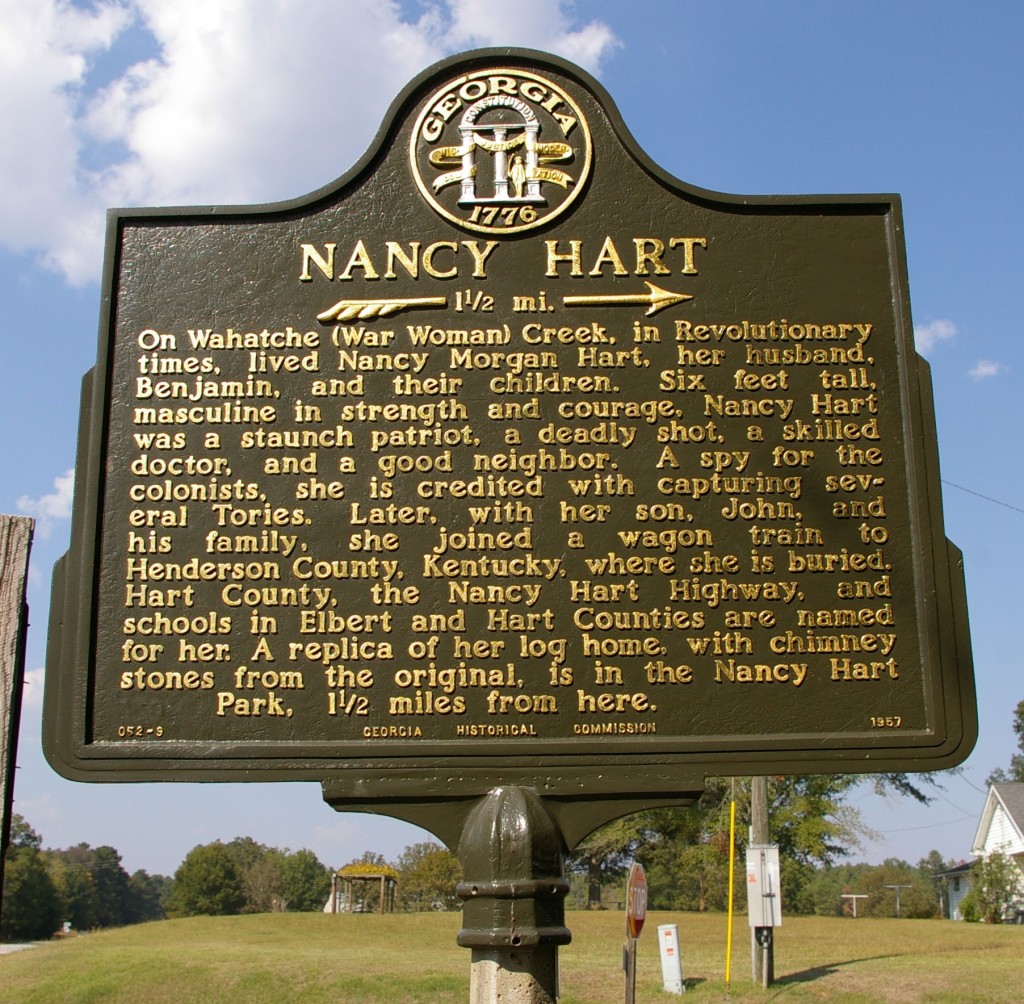
Nancy Hart Historic Sign
About Lake Hartwell Country
Lake Hartwell Country is one of 11 regional tourism offices in the state of South Carolina. These offices are called SCATR, or the South Carolina Association of Tourism Regions. Why are we called Lake Hartwell Country? We cover Anderson, Oconee, and Pickens counties, and Lake Hartwell touches all three of these counties. Lake Hartwell is also a major draw for tourism to the area, bringing in millions of visitors every year. In addition to tourism promotion, we also strive to preserve the history and culture of our region. Our Visitor Center is located on the historic Village Green in downtown Pendleton, SC. We also house one of the largest archive collections of local, historical artifacts, which can be found just down the street at the Bart Garrison Agricultural Museum of South Carolina. Additionally, we have an extensive genealogy library that is open to the public with information about the families who once lived in our region. Stop by to say hello!
Press Inquiries
Les McCall
les [at] lakehartwellcountry.com
(864) 646-3782
https://www.lakehartwellcountry.com
120 History Lane
Pendleton, SC 29670



