
LifeBot launches Medical Command Network to connect frontline care teams with remote physicians
Texas company introduces four connected stations for military medicine, with applications in emergency and disaster
Press Release Disclaimer: This is a press release distributed through the XPR Media network. It has not been independently verified by our newsroom.
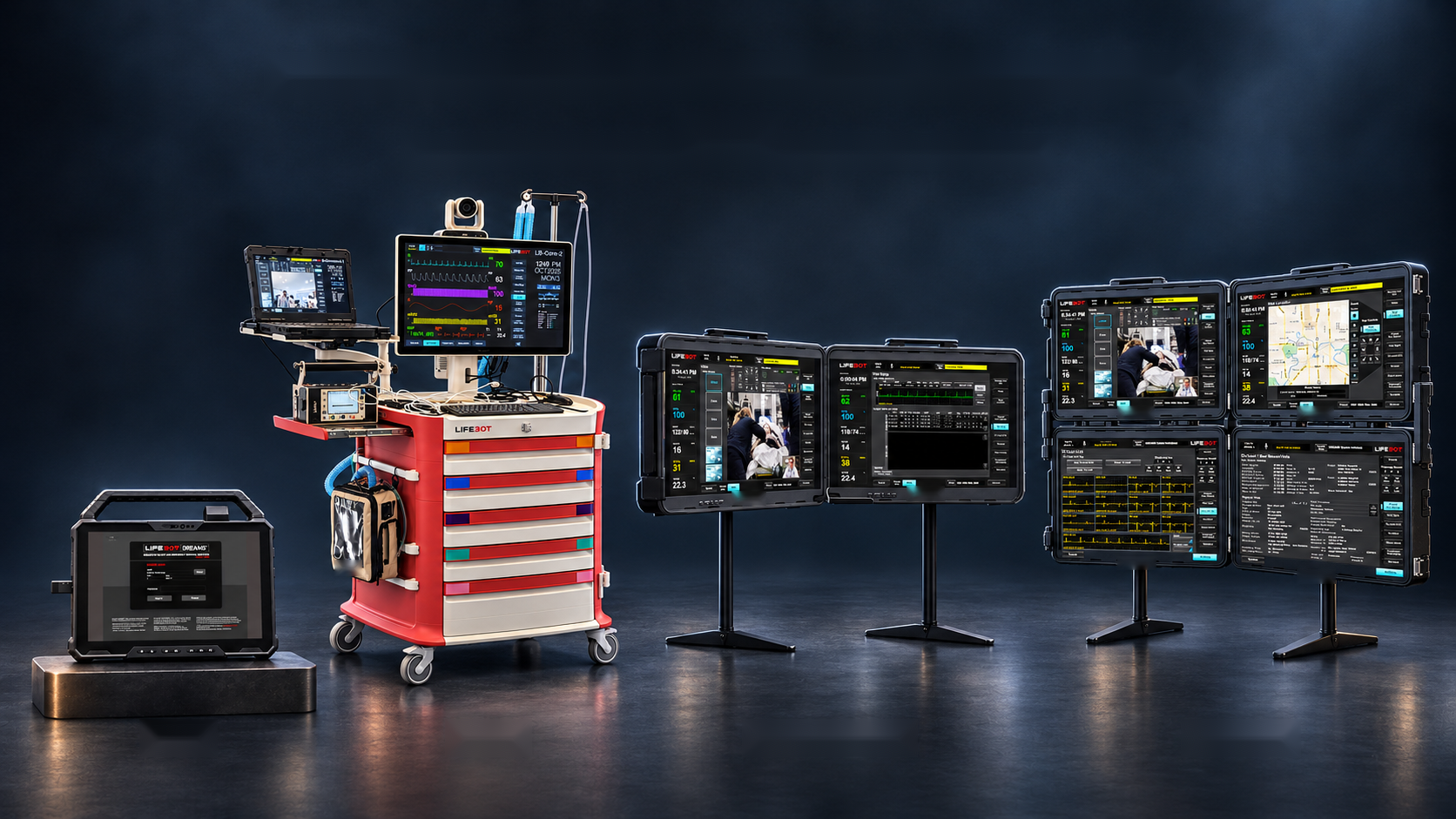

Texas company introduces four connected stations for military medicine, with applications in emergency and disaster responses.
TEXAS, TX, UNITED STATES, November 17, 2026 /EINPresswire.com/ — LifeBot Inc. has launched its Medical Command Network, a system designed to let frontline clinicians, remote physicians and medical coordinators share a patient encounter as care moves from the point of injury through evacuation and hospital handoff.
The Medical Command Network, left to right: LifeBot Link, LifeBot Core, LifeBot Command and LifeBot Matrix — rendering. Rendered from photographs of the product; demonstration data on the screens.
Introduced at the 46th ICMM World Congress of Military Medicine in Abu Dhabi United Arab Emirates, the network brings live video, vital signs, examination images and clinical documentation into one workflow.
For military medical teams, the network supports assessment, specialist consultation and coordination across deployed treatment locations and medical evacuation.
For emergency and disaster response teams, the same approach offers a way to share patient information and access remote clinical support where infrastructure is limited or disrupted.
“The patient moves. The clinical story should not reset. The LifeBot Medical Command Network connects medics, remote physicians and medical coordinators around a shared patient encounter, supporting continuity of care wherever the mission goes,” said Sherif Mohallal, President & CEO of LifeBot Inc.
Operating when connectivity is limited
The four stations, LifeBot Link, Core, Command and Matrix, run on DREAMS, LifeBot’s clinical workflow platform. Connected stations can operate together over a closed local network without internet access. Consultation with physicians outside that network requires an available communications link.
The shared clinical picture in DREAMS: live video, vital signs and waveforms — demonstration data (screen capture).
Link and Core also support local sign-in, measurements and documentation when operating independently, with synchronization when connectivity is restored. Command supports local documentation and review.
LifeBot’s Intelligent Communications Management software manages the connections supplied for deployment, including Ethernet, Wi-Fi, cellular, FirstNet Band 14, satellite and data radio. It switches supported traffic to an available alternative when an active connection drops.
A shared clinical picture
Clinicians can share videos from up to six selectable sources, vital signs and waveforms from the LifeBot Interceptor monitoring module, 12-lead ECG, ultrasound and examination images, and clinical notes. A remote physician can request a blood pressure reading or ECG; the clinician beside the patient accepts and performs the request, retaining responsibility for treatment.
Link is a rugged tablet workstation for patient-side assessment, documentation and consultation. Core brings the workflow to a mobile cart, with monitoring and treatment equipment configured for the mission. Command gives physicians and specialists a consultation workstation. Matrix lets medical coordinators view participating units, signed-in personnel, connections and received records.
The workflow records handoff as a separate step, with the departing team signing the record and the receiving clinician signing on acceptance. Vehicle and aircraft installations, including mounting, power and communications, are specified for each platform and program.
Every station includes user and role controls, configured authentication and application auditing. Link and Core include full-disk encryption. Encrypted communications and hosting on customer premises or in a private cloud are configured for each deployment.
US military research heritage
DREAMS was developed from 1998 to 2006 under cooperative agreements with the U.S. Army Medical Research and Materiel Command. LifeBot holds the exclusive worldwide license to DREAMS from the Texas A&M University System, obtained in 2011 following a 2010 option.
Since 2014, LifeBot has designed, supplied and sustained medical-equipment integration for two General Dynamics Land Systems–Canada armored-ambulance variants using the LifeBot 5 generation. The LifeBot 10 generation was evaluated by NASA in ground studies in 2024–25. The four stations introduced at ICMM 2026 are a new generation.
LifeBot Link, Core, Command and Matrix are available to order.
Product fact sheets, images and interviews with the President & CEO are available on request.
Shireen Shakeel
Cosmopole Group FZ LLC
LifeBot@Cosmopole.com
Legal Disclaimer:
EIN Presswire provides this news content “as is” without warranty of any kind. We do not accept any responsibility or liability
for the accuracy, content, images, videos, licenses, completeness, legality, or reliability of the information contained in this
article. If you have any complaints or copyright issues related to this article, kindly contact the author above.

Media gallery
