GE HealthCare’s Phase 2 Results Support Advancement of Investigational Manganese-Based MRI Contrast Agent Mangaciclanol Into Phase 3 of LUMINA Clinical Trial
Key milestone in GE HealthCare’s adaptive Phase 2/3 LUMINA clinical trial, with Phase 2 results meeting primary
Press Release Disclaimer: This is a press release distributed through the XPR Media network. It has not been independently verified by our newsroom.


GE HealthCare (Nasdaq: GEHC) today announced Phase 2 results support advancement into Phase 3 for its international, multicenter LUMINA trial of mangaciclanol, with a dose selection of 0.1mmol/kg. Mangaciclanol is an investigational manganese-based magnetic resonance imaging (MRI) contrast agent (MBCA). If approved, MBCAs could offer an alternative to – or even replace – gadolinium-based contrast agents (GBCAs), the current standard of care. This is because of their potential to address concerns with gadolinium-based contrast agents around retention in the body, supply chain resiliency, and the environment. This milestone comes seven months after the first patient was dosed at Mayo Clinic in April 2026, and builds on Phase 1 results showing the agent was well tolerated.
This press release features multimedia. View the full release here: https://www.businesswire.com/news/home/20261119117575/en/
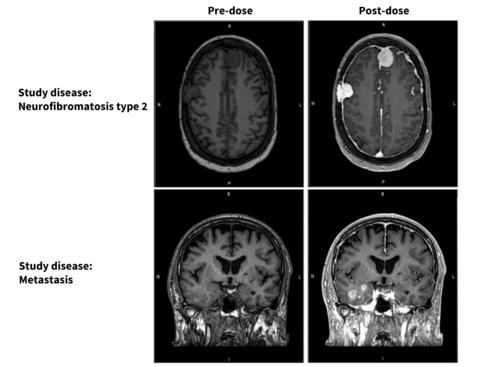
Representative pre- and post-mangaciclanol images in patients from the LUMINA Phase 2/3 trial
The Phase 2 stage of the adaptive Phase 2/3 trial design is a dose-finding study in adult patients with known or highly suspected lesions referred for contrast-enhanced MRI of the central nervous system. Participants received both mangaciclanol and gadobutrol, a gadolinium-based agent, with their images compared side by side by blinded independent readers. The primary endpoint, overall diagnostic preference, was met, with diagnostic preference similar between mangaciclanol and gadobutrol. Lesion visualization and quantitative imaging findings were generally similar, and mangaciclanol was well tolerated, with no safety concerns identified following its administration. Safety will continue to be evaluated in Phase 3. LUMINA is being conducted at clinical sites in the United States, Europe and Asia.
Dr Robert J. McDonald, M.D., Ph.D., neuroradiologist at Mayo Clinic, U.S., and one of the principal investigators of the LUMINA study, said, “For years, clinicians and patients have asked whether we can achieve the diagnostic confidence of gadolinium without the concerns around tissue retention and nephrogenic systemic fibrosis risk. These Phase 2 results are an important step toward answering that question. Seeing a manganese-based agent perform this well under blinded comparison with an established gadolinium agent is encouraging, and I look forward to what Phase 3 will show across a broader range of patients.”
Kevin O’Neill, President & CEO of Pharmaceutical Diagnostics (PDx), GE HealthCare, said, “These positive Phase 2 results support dose selection for Phase 3, which will further evaluate the efficacy and safety of mangaciclanol-enhanced MRI for detecting and characterizing lesions of the central nervous system and body. As aging populations and the rising burden of chronic disease drive demand for imaging, we continue to invest in our contrast media portfolio and in what comes next. Manganese-based contrast agents have the potential to transform the MRI market, helping meet the evolving needs of clinicians and patients.”
Approximately one-third of global MRI procedures require a contrast agent,1 and around 65 million contrast-enhanced procedures are performed globally each year using GBCAs as the current standard of care.2 Unlike gadolinium, manganese is an endogenous element, present in our food, and naturally occurring and autoregulated in the body. Mangaciclanol’s macrocyclic “cage-like” structure is designed to minimize the possibility of retention in the body. Gadolinium is a rare-earth metal largely dependent on mining and processing infrastructure in China, whereas manganese is an essential element abundantly available from multiple countries. Furthermore, as manganese is naturally found in water sources, MBCAs could reduce environmental concerns associated with excreted contrast agents.
Mangaciclanol has received Fast Track designation by the U.S. Food and Drug Administration (FDA), which expedites the review of new therapeutics and medical imaging agents that have the potential to address significant unmet patient needs. Mangaciclanol is an investigational agent and is not currently approved for use by the FDA or any other regulatory authority. Its safety and efficacy have not been established.
GE HealthCare’s PDx segment is a global leader in imaging agents used to support 140 million patient procedures per year globally,3 equivalent to four procedures every second. For more than 40 years, GE HealthCare contrast media has been routinely used across MR, X-ray, CT and ultrasound to enhance clinical images and support diagnosis.
GE HealthCare will present preliminary Phase 2 trial results with clinical images, at RSNA in McCormick Place, Chicago, on Tuesday 1 December 12:00-13:00 at the Industry Expert Theater in South Hall A.
References:
- Contrast Agents of Magnetic Resonance Imaging and Future Perspective. Nanomaterials. Available at: https://pmc.ncbi.nlm.nih.gov/articles/PMC10343825/
- Recent Developments and Future Perspectives in Magnetic Resonance Imaging and Computed Tomography Contrast Media. Investigative Radiology. Available at: https://pmc.ncbi.nlm.nih.gov/articles/PMC12871431/
- GE HealthCare press release: GE HealthCare Invests $138 Million in Cork, Ireland Manufacturing Facility to Address Increasing Contrast Media Demand
About GE HealthCare Technologies Inc.
GE HealthCare is a leading global healthcare solutions provider of advanced medical technology, pharmaceutical diagnostics, and AI, cloud and software solutions that help clinicians tackle the world’s most complex diseases. Serving patients and providers for 130 years, GE HealthCare is delivering bold innovations designed for the next era of medicine across its Advanced Imaging Solutions, Pharmaceutical Diagnostics and Patient Care Solutions segments to help clinicians deliver more personalized, precise patient care. We are a $20.6 billion business with approximately 54,000 colleagues working to create a world where healthcare has no limits.
GE HealthCare is proud to be among 2026 Fortune World’s Most Admired Companies™.
Follow us on LinkedIn, Facebook, Instagram, or visit our website for our latest news and perspectives.
Forward-Looking Statements
This release contains forward-looking statements. These forward-looking statements might be identified by words, and variations of words, such as “will,” “expect,” “may,” “would,” “could,” “plan,” “believe,” “anticipate,” “intend,” “estimate,” “potential,” “position,” and similar expressions. These forward-looking statements may include, but are not limited to, statements about the transaction, the completion and expected results of the transaction including the financial performance of the business, industry positioning, and GE HealthCare Technologies Inc.’s (“the Company’s”) business, products, growth opportunities, and strategy. These forward-looking statements involve risks and uncertainties, many of which are beyond the control of the Company. Factors that could cause the Company’s actual results to differ materially from those described in its forward-looking statements include, but are not limited to, the conditions to the completion of the transaction may not be satisfied; closing of the transaction may not occur or may be delayed; the Company may be unable to achieve the anticipated benefits of the transaction; operating costs and business disruptions (including, without limitation, difficulties in maintaining relationships with employees, customers, and suppliers) may be greater than expected; the Company may assume unexpected risks and liabilities; and completing the transaction may distract the Company’s management from other important matters. Other factors that may cause such a difference also include those discussed in the “Risk Factors” section of the Company’s Annual Report on Form 10-K filed with the U.S. Securities and Exchange Commission and any updates or amendments it makes in future filings. There may be other factors not presently known to the Company or which it currently considers to be immaterial that could cause the Company’s actual results to differ materially from those projected in any forward-looking statements the Company makes. The Company does not undertake any obligation to update or revise its forward-looking statements except as required by applicable law or regulation.
View source version on businesswire.com: https://www.businesswire.com/news/home/20261119117575/en/
Media gallery