Resilient Core Systems, Inc. Expands Into Advanced Compute and Thermal Infrastructure as Data Center Pressures Intensify
Atlanta-based Resilient Core Systems, Inc. files patent protection for new thermal technology addressing power, water
Press Release Disclaimer: This is a press release distributed through the XPR Media network. It has not been independently verified by our newsroom.
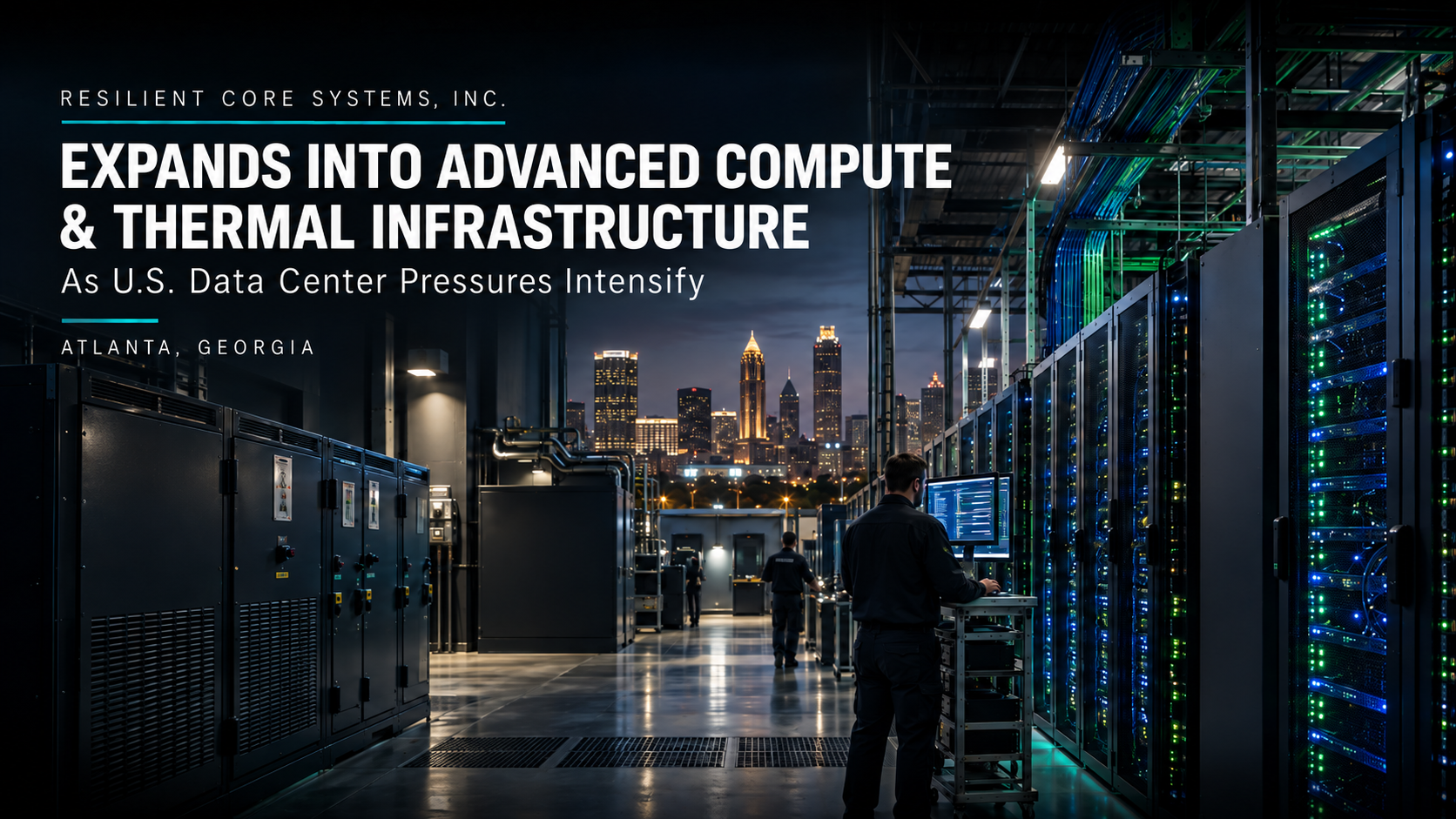

Atlanta-based Resilient Core Systems, Inc. files patent protection for new thermal technology addressing power, water and cooling pressures.
ATLANTA, GA, UNITED STATES, September 24, 2026 /EINPresswire.com/ — Resilient Core Systems, Inc. is expanding its technology development portfolio into advanced compute and thermal infrastructure as rapidly growing data-center demand places increasing pressure on U.S. power, water, and cooling systems.
The expansion comes as artificial intelligence and high-density computing accelerate demand for data-center capacity across the United States, increasing scrutiny of the physical infrastructure required to support that growth.
A June 2026 Lawrence Berkeley National Laboratory report estimates data centers could account for approximately 11.8% of total U.S. electricity consumption by 2030, with modeled scenarios ranging from 9.5% to 15.3%. The U.S. Department of Energy has identified expansion of energy infrastructure, computing capacity and grid resources as central to supporting continued AI growth.
Lawrence Berkeley National Laboratory report
The Infrastructure Challenge Is Becoming a Regulatory Issue
The pressure is no longer theoretical.
On September 21, 2026, Texas directed the Texas Commission on Environmental Quality to halt permits sought by data centers until the Electric Reliability Council of Texas completes an ongoing audit. The state is examining electricity demand, water consumption, water sources and other infrastructure impacts associated with data-center development.
Texas Data Center Permitting Directive
Days earlier, Loudoun County, Virginia one of the nation’s most concentrated data-center markets approved a plan to pause action for up to 12 months on certain data-center and electrical-substation applications while reviewing its policies and regulations.
Loudoun County Data Center Policy Review
Other jurisdictions are increasing oversight. Tucson, Arizona, adopted regulations addressing water and power supply, environmental review, noise and backup-power emissions for large-scale data centers.
City of Tucson Large-Scale Data Center Regulations
RCS Enters the Thermal Infrastructure Challenge
Against this backdrop, Resilient Core Systems, Inc. has filed patent protection for a new advanced thermal infrastructure technology being developed for high-density computing environments. The technology is currently patent pending.
The company is intentionally limiting public disclosure of the underlying architecture while its
intellectual property and R&D activities advance.
Rather than approaching data-center growth solely as a computing problem, RCS is examining the infrastructure surrounding compute including thermal management, energy efficiency, water dependence, equipment-level heat management and the ability to scale increasingly dense computing environments.
“Artificial intelligence may exist in software, but the infrastructure that makes it possible is very physical,” said Maurice Dillard, Founder of Resilient Core Systems, Inc. “Every increase in computing density eventually becomes a question of power and heat. When communities, utilities and governments are beginning to ask whether the existing infrastructure model can keep scaling, that tells us the problem has moved beyond the server and into the infrastructure around it.”
The initiative represents an expansion of RCS’s technology portfolio not a departure from its
existing disaster recovery and resilience work and establishes Advanced Compute & Thermal Infrastructure
as a second critical-infrastructure technology domain.
RCS expects the technology to advance through research, engineering, prototyping and performance validation before broader commercialization. The company has not publicly disclosed its commercial name, detailed engineering configuration or anticipated market availability.
“There is a difference between announcing an idea and building technology that can survive serious engineering scrutiny,” Dillard said. “We have filed our patent protection. Now our focus is development, validation and building the technical foundation required to participate seriously in this industry over the long term.”
As AI computing becomes denser, more power is concentrated into smaller spaces, increasing heat and cooling demands on electrical and mechanical systems. Cooling choices can also affect water consumption, making
About Resilient Core Systems, Inc.
Resilient Core Systems, Inc. is an advanced infrastructure technology company with its principal office in Atlanta, Georgia. The company develops intelligent systems and advanced technologies for critical infrastructure, with technology development spanning Disaster Recovery & Resilience and Advanced Compute & Thermal Infrastructure.
Resilient Core Systems, Inc. is developing technology intended to improve the systems, infrastructure and operational environments on which governments, enterprises and communities increasingly depend.
The company’s expansion into advanced compute and thermal infrastructure builds upon its broader strategy of identifying critical infrastructure problems, protecting intellectual property around new approaches, and advancing those technologies through research and engineering toward real-world deployment.
Maurice Dillard
Resilient Core Systems Inc.
crm@resilientcoresystems.com
Visit us on social media:
LinkedIn
Instagram
Facebook
X
Legal Disclaimer:
EIN Presswire provides this news content “as is” without warranty of any kind. We do not accept any responsibility or liability
for the accuracy, content, images, videos, licenses, completeness, legality, or reliability of the information contained in this
article. If you have any complaints or copyright issues related to this article, kindly contact the author above.

Media gallery