Study: High fuel costs, shipping capacity constraints to drive pricey holiday peak season
ATLANTA, Oct. 13, 2026
Press Release Disclaimer: This is a press release distributed through the XPR Media network. It has not been independently verified by our newsroom.

Study: High fuel costs, shipping capacity constraints to drive pricey holiday peak season
PR Newswire
ATLANTA, Oct. 13, 2026
Q4 TD Cowen/AFS Freight Index projects impact of elevated fuel prices on transportation costs in busy year-end shipping season
- Most expensive parcel shipping year on record to end with all-time high package delivery prices, spurred by elevated fuel costs, seasonal surcharges and constrained capacity
- Truckload freight pricing to approach highs not seen since 2022 as continued regulatory action, carrier exits and fuel shocks squeeze available capacity
- Despite declining tonnage, tight pricing control by carriers and elevated fuel costs push the LTL rate per pound index to an all-time high for the third straight quarter
ATLANTA, Oct. 13, 2026 /PRNewswire/ — AFS Logistics and TD Cowen announce the fourth quarter (Q4) 2026 release of the TD Cowen/AFS Freight Index, a snapshot with predictive pricing for truckload, less-than-truckload (LTL) and parcel transportation markets. The latest data illustrates the potent effects of a structurally higher-cost transportation environment, with entrenched high fuel prices, capacity constraints and peak-related fees driving rates to historic highs. The index projects an expensive Q4, with holiday shippers facing record-high ground and express parcel costs, the highest truckload rates since Q1 2022 and LTL rates eclipsing 80% above the January 2018 baseline for the first time ever.
“We expect fuel to drive elevated transportation costs for the foreseeable future. Inventories are low and refineries are at capacity, so even if crude oil prices drop in the coming months, diesel and jet fuel supplies must still catch up before prices recede,” says Andy Dyer, CEO, AFS Logistics. “The other key force shaping freight markets is capacity. The holiday rush always places a seasonal premium on parcel capacity, while the continued ascent of truckload rates is the result of steady demand chasing a shrinking pool of trucks.”
Parcel: Perfect storm for a pricey peak season
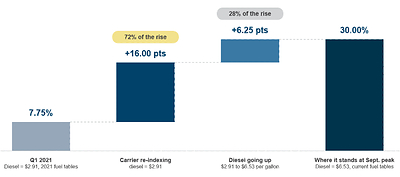
Projections for Q4 solidify 2026 as the most expensive parcel shipping year on record, a testament to years of carrier pricing changes designed to maximize revenue in a broad range of market conditions. The fuel surcharge is a prime example, with carriers frequently reindexing surcharge tables since 2021 to not only capture additional revenue as fuel prices rise but keep fuel surcharges high even as actual fuel prices fall. For example, the chart in figure 1 shows the fuel surcharge growing from 7.75% in Q1 2021, when the average diesel fuel price was $2.91 per gallon, to 30% in September 2026 when diesel prices peaked at $6.53 per gallon. But of the 22.25-point increase from Q1 2021 to September 2026, 72% of the change is the product of carrier adjustments to fuel surcharge tables, not the price at the pump. Even if fuel prices returned to $2.91 per gallon, the fuel surcharge today would be 23.75% — roughly three times higher than in Q1 2021.
“While diesel and jet fuel are major costs for ground and express parcel, the fuel surcharge has become a revenue lever for carriers in addition to a pass-through mechanism for covering the cost of doing business,” says Mingshu Bates, Chief Analytics Officer and President of Parcel, AFS Logistics. “Even if crude oil normalizes and fuel prices recede, the effective fuel surcharge will not show a material decrease.”
The recently announced FedEx general rate increase (GRI) includes another subtle-yet-potent surcharge change, reclassifying 2,533 ZIP codes from extended delivery area surcharge (DAS) to remote DAS — the most expensive DAS tier. For packages destined for ZIP codes reclassified from extended to remote, that DAS fee jumps to $17.75 when the GRI takes effect Jan. 4, 2027 — roughly doubling the fee for residential deliveries and more than tripling it for commercial destinations.
In the near term, the holiday season means capacity comes at a premium, with peak package volumes driving more intense competition for space on trucks and peak-focused demand surcharges making an impact on invoices. With structural and seasonal tailwinds pushing pricing higher, the ground parcel rate per package index is projected to set a record high in Q4 2026, reaching 43.3% above the January 2018 baseline — a 5.8% year-over-year (YoY) increase and up 3.2% from the previous quarter. The numbers tell a similar story in express, with the express parcel index projected to set a record high for the fifth straight quarter, reaching 20.3% in Q4, a 13.8% YoY increase.
“For shippers, peak season involves a year-long tight-rope act of balancing volume across carriers to maintain access to capacity when orders really need to move and to limit the impact of demand surcharges that incrementally penalize volume that exceeds baselines established earlier in the year,” says Bates. “The holiday peak also tends to accelerate the trend of alternative carriers continuing to gain share from the large incumbents, as shippers diversify to shield themselves from capacity risk and surcharge impact.”
LTL: Sky-high fuel costs and carrier pricing power send rates to the moon
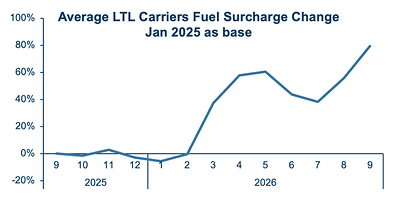
While frequent changes by parcel carriers have increasingly divorced fuel surcharge trends from actual fuel price movements, LTL is a different story. In LTL freight, the fuel surcharge closely mirrors diesel price trends, as evidenced by the chart in figure 2 spiking in the early months of the Iran war, subsiding in the early summer and increasing sharply again to 79% above the September 2025 level when diesel prices spiked to an all-time high of $6.53 per gallon in September.
While declining shipment weight continued to weigh against cost per shipment in Q3, accelerated midyear GRIs and elevated fuel surcharges propped up costs. Disciplined pricing and elevated fuel costs are projected to continue upward pricing momentum and make Q4 2026 the third straight quarter with an all-time high. The LTL rate per pound index is expected to reach 82.5% above the January 2018 baseline — up 8.8% YoY and the first quarter on record to break 80%.
“Underlying LTL demand remained soft in 2026, as evidenced by national carriers reporting mid-single-digit tonnage declines,” says Mich Fabriga, Vice President of LTL Pricing for AFS Logistics. “But through the combination of spiking fuel prices and a sustained commitment by carriers to prioritizing only profitable loads that fit their networks, LTL pricing has remained exceptionally strong.”
Truckload: Rates reach highest levels in over four years, despite limited demand signals
This time a year ago, the truckload rate per mile index was still looking for relief from the excess capacity that had suppressed rates for nearly three years. Since then, truckload rates have seen a steady recovery, climbing from 7.6% in Q4 2025 all the way to 19.7% above the January 2018 baseline in Q3 2026. But while tightening capacity has driven up prices, a demand-side catalyst remains conspicuously absent and sky-high diesel costs have left some carriers vulnerable, as evidenced by recent news of 16 trucking companies filing for bankruptcy in a 30-day period.
A deeper look at gross domestic product (GDP) figures supports the picture of stubbornly soft demand. While GDP grew 2.2% in Q2 2026, that growth is consistent with low freight demand as it remains concentrated in services and investments, rather than goods that require transportation. Yet the supply side squeeze remains powerful, with government regulatory enforcement actions taking drivers off the road and closing training locations, a sign that capacity is unlikely to rebound at the historical replacement rate and pulling forward the risk of a utilization squeeze and rate escalation. In Q4 2026, the freight index is projected to reach 23.4% above the January 2018 baseline, up 14.7% YoY and the highest level since Q1 2022.
About the TD Cowen/AFS Freight Index
The TD Cowen/AFS Freight Index launched in October 2021, offering a unique perspective on the transportation market through its dataset, forward-looking view and perspective on parcel shipping. Expected rate levels are derived from billions in annual transportation spend across all modes and includes actual net charges that factor in accessorial fees such as fuel surcharges. Past performance and machine learning produce predictions for the remainder of the quarter, set against a baseline of 2018 rates for each mode.
About AFS Logistics
AFS is a group of shipping strategists that helps more than 1,800 companies across 35 countries better understand their freight costs. The company has over $11 billion in transportation spend under management, and uses that data along with decades of truckload, LTL and parcel experience to help advise, optimize and manage client shipping programs. AFS provides support throughout the process of buying, planning, executing and settling transportation services, constantly assessing performance to ensure shippers only pay what they should and get the service and operational outcomes they deserve.
The company was founded in 1982 and employs more than 380 teammates across the U.S. and Canada. AFS is regularly part of the Inc. 5000 list of fastest growing companies. To learn more, visit www.afs.net.
 View original content to download multimedia:https://www.prnewswire.com/news-releases/study-high-fuel-costs-shipping-capacity-constraints-to-drive-pricey-holiday-peak-season-302907155.html
SOURCE AFS Logistics